
Are you tired of juggling multiple keys to access different areas in your building? Did you know that door access control systems can simplify this by using one card or even your fingerprint? This blog post will explain how these systems work and how they improve security.
Keep reading to find out more!
What is a Door Access Control System?
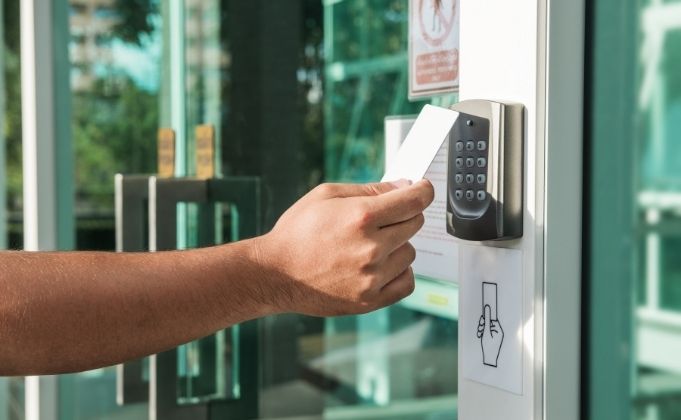
A door access control system manages entry into a building or facility. It uses various methods, such as key cards, fingerprints, and facial recognition, to unlock doors. These systems are becoming more popular in the UK as they add an extra layer of security for homes and businesses.
Types include key card systems, fingerprint scanner systems, and facial recognition systems. The system scans credentials; if correct, it unlocks the door; if wrong, it stays locked.
This offers customisation based on specific security needs.
Components of a Door Access Control System
A door access control system consists of several key parts that work together. Each part plays an essential role in managing entry and ensuring security.
Credential (Card, Fob, Tag, etc.)
Credentials, like cards, fobs, or tags, are key elements in an access control system. They contain an electronic coil and a unique ID code. A reader energises this coil with low-energy pulses to recognise the credential.
Different types of credentials exist. These include key cards, badges, proximity cards, and key fobs. Biometric credentials such as fingerprints also play a role. PINs or passcodes can work, too.
Mobile phones now serve as credentials in many systems via apps.
Card Reader
Card readers play a vital role in door access control systems. They include types such as keypads, swipe cards, RFID doors, biometric doors and smart lock door readers. Swipe card readers require users to swipe key cards or badges for entry.
RFID (Radio Frequency Identification) door readers use information tags and radio signals. Biometric door readers scan physical features like fingerprints or facial recognition for access.
Smart lock door readers combine multiple technologies, offering flexibility in security systems. Each type enhances the safety and convenience of keyless entry systems.
Door Controller
The card reader sends credential data to the door controller, which, based on this data, determines whether access should be granted.
Door controllers can work alone or as part of another device. Secure databases constantly update and communicate with these controllers in real-time. Advanced systems perform multiple backups each day to ensure safety.
Administrators can manage user permissions and create reports through user portals connected to the system.
Lock and Door Position Sensor
Access control systems use locks to secure entry points. Fail-safe locks unlock when they get voltage, while fail-secure locks unlock during power loss. This ensures the door remains locked even if there is no power.
Door position sensors detect whether a door is open or closed. Security sensors trigger alerts if someone tries to force entry. These sensors log events for security audits and provide peace of mind by showing the door’s status in real-time.
Conclusion
A door access control system enhances security and simplifies entry management. It grants access using various methods, such as key cards or biometrics. These systems customise settings for businesses and homes, providing flexibility for specific needs.
They offer a secure, convenient way of managing who can enter your building.


